Front Handspring, Skill Development, Training, Tumbling

The Front Handspring Step-Out (Walkover)

front hndsprng stepout

The Front Handspring step-out, also known as the Front Walk-over in cheerleading and dance is a common skill and one that is used often in combination tumbling passes. It is also considered an elegant skill, if performed correctly, but difficult to learn properly for many athletes. Here I will share my thoughts and techniques that has worked well in teaching this skill.

As with so many skills, it is important to learn the prerequisites first so the student has the ability to learn the Front Handspring correctly. These prerequisites include, but not limited to, the handstand, bridge, lunge, and hurdle step.

There are several factors that go into play when developing these types of skills. For this particular skill, flexibility certainly is one of the most important factors. This flexibility concerns primarily the legs, back, and shoulders. Arm and body positioning is another factor that must be accomplished for a positive result. And finally, strength and aggression are important.

spotting front limber

The front limber is a skill that should be introduced and learned prior to learning the front handspring. This will prepare the student in understanding the dynamics of the skill. There are several good drills used in learning the front limber. The most effective drill that has worked well for my students is the bridge “rock and stand” motion.  This should be spotted by a qualified coach through the developmental stages.

While the student is in the bridge position, they will rock back and forth and as they rock toward the feet, have them stand upward making sure the student keeps their eyes on the floor and not looking upward or forward. Upon the finish of the skill, the body should be in a slightly arched position.

Limber position

Once the student understands the front limber, they are ready to begin learning the front walkover. The concept is very similar to the front limber, however, the student will keep their legs split throughout the skill and land on one leg. This is where flexibility plays a major roll. The farther the student can split their legs, the easier it is for the student to land with the lead leg under the torso. Shoulder flexibility also plays a roll which will allow the student to place the lead foot close to the hands.

20171006015256

When the student has learned (or trained and understands) the front walkover, they would be ready to perform the skill from a run and hurdle step. It is critical that the student has a proper hurdle step in order to perform the front handspring The Hurdle Step The Key Ingredient. Arms should be straight and extended up above the head and ears throughout the skill.

The arms should reach well in front of the body when placing the hands on the floor. It is important that the shoulders do not rock in front of the hands. The arms should remain straight and should create a blocking action (bounce) off the floor. The block should be felt on the palms of the hands (if the shoulders rock forward upon placing hands on the floor, the pressure would be on the fingers preventing the blocking motion).

finish pos of front walkover

The finish of the skill should be the same as in the standing front walkover. The major difference between the front walkover and front handspring step-out is the blocking motion off the arms.  The stronger the blocking motion, the more momentum created for connecting skills.

If the students follow this  type of training progression, they will learn the skill effectively.  It will take time and consistency but the results should be positive.  It is always important to remember to follow the proper techniques so the students will not develop bad habits.

dsc_40031119621626161690471.jpg

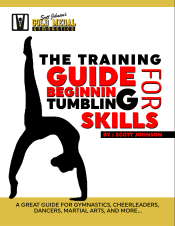
My new Beginner Tumbling Training Guide is published and ready for all to use. This is a great training aid for any and all programs who offer tumbling training. If you would like to order your copy, follow this link: http://www.amazon.com/gp/product/B0847D3VQC

Front Cover.Red Lettering

Benefits, Gymnastics, Skill Development, Sports, Training, Tumbling

How Can Gymnastics Benefit Your Child?

It is very important to keep children active and get involved with some type of physical activity. Especially in this modern age where technology has taken control and children get glued to their computers and mobile devices. In addition, the majority of public school systems have little to offer in terms of Physical Education and intramural sports – where many schools only offer PE classes as an option in the school curriculum.

However, when searching which activities are best to get your young child involved with, there are many choices. I believe Gymnastics is a great place to start!! There are many benefits in learning gymnastics as a young athlete.

All sports have their own physical attributes which need to be accomplished in order to be successful. For example, in sports such as basketball, track and field, and soccer, just to name a few, athletes need to be proficient in running and jumping as well as throwing and spinning. Dancers need to be flexible and learn complete body control and coordination.

The sport of gymnastics teaches most physical attributes that all sports require in order to be successful. Gymnastics entails training in flexibility, strength, agility, and coordination. It is important the students learn to run and jump effectively. Through consistent training, students will increase physical coordination and agility. The sport of gymnastics and tumbling entails training that enhance development in all parts of the body.

Skill development in gymnastics is typically a slow process due to the complexity of the skills involved. However, through time, students will learn and progress to higher level skills. It is through this development that students develop physical and emotional attributes that will be beneficial in other sports they may pursue.

Only a small percentage of students who participate in gymnastics at an early age will reach the highest level of competition. For students who participate in gymnastics at an early age and progress through several skill levels, they will have developed many physical and mental attributes that will help them become successful in another sport.

Not only is gymnastics and tumbling beneficial to students, it is a fun experience for most who participate. Give it a try – it could be a great experience!!

My new Beginner Tumbling Training Guide is published and ready for all to use. This is a great training aid for any and all programs who offer tumbling training. If you would like to order your copy, follow this link: http://www.amazon.com/gp/product/B0847D3VQC

These neoprene wrist supports are the best for gymnasts and cheerleaders experiencing wrist pain. The neoprene provides support and warmth to the joint to help relieve pain discomfort.

This is the best syle of leotards for recreational gymnastics. Get yours today!!

Coaching, Confidence, Gymnastics, Preparation, Skill Development, Tumbling

Skill Development: Why Can’t I Get It?

There is no doubt that gymnastics and tumbling skills are difficult to achieve. Those that are familiar with the sport, understand the dynamics and the time it takes to achieve skills. It is a sport where it may take months and even years for a student to achieve a particular skill. But why can’t a student achieve a skill that they have been working on for so long? There may be many reasons but the most common are fear factors or technical errors. Both of which can be fixed and overcome.

It is essential that students build a strong foundation of basic elements when they start their tumbling training. Skills build upon one another as the sport progresses so having good technique with basic skills will allow faster and more positive progression. 

For example, if a student has a great round-off, connecting a back handspring will be easier to accomplish. However, if the round-off is done poorly, the student would not be in a position to connect a successful back handspring. In fact, it is very common that when you see a student bust on a round-off,  back handspring, it is not the back handspring that is the problem – it is the round-off.

When a student is struggling with achieving a skill, the coach needs to determine “why”. If it is a fear problem, the coach should take the time to continue drill training and spotting to help the student gain confidence. This should eliminate the fear over time.  If the student is forced to attempt the skill when they are terrified, there is a good chance of an accident – and this would certainly increase the fear and prolong the accomplishment.

With more complex and difficult skills such as the back full twist or double full twist, the problem becomes more common in students struggling to achieve them.  The most common problem here is the lack of proper technique.  It becomes very frustrating for the student when they are not able to get the skill.

When learning these types of skills, there are prerequisites that need to be accomplished first – and accomplished correctly.  To learn a back full twist, the student must first learn a proper back layout -which is not an easy skill to accomplish properly. To learn a good back layout, the student must have a great round-off and back handspring.

If these prerequisites are not accomplished with good technique,  the student may never learn their desired skill.  I’ve worked with many students who fall into this category and the last thing they want to do is take a step back and work to perfect the basics. However, this is what must be done if they are going to learn the more difficult skills.

The bottom line in this scenario is that steps should not be skipped in skill development. Why can’t they get it?  More than likely, too many steps were skipped early in their development.

Scott Johnson – 1984 Olympic Gold Medalist

My training manuals: “Beginner Tumbling Training” and “The Round-Off and Back Handspring”.  These are useful tools in training for all and any athletes needing to learn proper technique and safety. Great for gymnastics, cheerleading, dance, martial arts, and more.

Cheerleading and Tumbling, Coaching, Skill Development, Training, Tumbling

The Hurdle Step – The Key Ingredient


Learning how to tumble properly, safely, and in a manner where progression is desired, students need to learn many fundamental skills. There is a lot of focus on skills that are not only desired by the athlete, but also required by the sport or activity. This may include such skills as forward and back walkovers, cartwheels, aerials, and front and back handsprings. Several of these skills take a lot of time and training to achieve. In many cases, it may take years to learn how to accomplish these skills. But one skill that is overlooked and not a major focus of development is the Hurdle Step.

Although many may think this is a petty skill that should not need serious attention, it is actually a very important skill that must be trained and learned properly. The Hurdle Step precludes most tumbling skills that begin with a run or stepping motion. These will include the cartwheel, round-off, aerials, front handsprings, etc. If the hurdle is not proficient, it will affect the result of the following skills.

The hurdle step (skipping motion) is a combination of several different elements.  It begins with a run or jumping motion we call a power hurdle.  It also entails a hopping motion and ends in a lunging position.   All of these elements should be a focus on developing correctly for the hurdle to be proficient.

In the sport of tumbling and gymnastics, it is important that the athletes learn to run correctly.  It is very common to see many students not being able to run with proper technique.  Body position, stride length, and arm movements are elements that affect a proper run.  The most common problem athletes have is the stride length.  Many take small and very short strides while running.  This may cause the athlete to have more of a forward lean than necessary and could cause the athlete to “trip”.  When we see track and field athletes at the highest levels of participation, their stride lengths are incredibly long.  This not only produces speed for the run, but also more power.  When the run has short or small steps, it will make the hopping motion in the hurdle a challenge.

Within the hurdle, there is a hopping motion where the athlete hops on one foot.  In most cases, we see a very short hopping motion that may be less than foot long.  The hop should be long and travel several feet, as in the stride motion of the run.  A short hop will certainly create a tripping motion while the athlete initiates the following skill like the round-off or front handspring.  There will be almost no control in the connecting skill.  I will often break this down and have the students train on that hopping motion.  In almost every case (with the exception of advanced tumblers), students can hop further from a static position than from a running motion.  The most common reason for this short hop is the steps of the run prior to the hop.  If the athlete has too much of a forward lean in the run, the hop will likely be short.

The finish of the hurdle step should end in a lunge position.  This position will vary depending on the level of the athlete.  In more advanced levels, this lunge position will have more of a forward lean and a very large stride position.  This is due to higher speed and aggression of the tumbling pass.  At the lower levels, the lunge should be more of an upright position.  This will allow the athlete to control their arms and body positions while preparing for the next skill.

In many cases, when we see a student struggling with performing skills such as the  round-off, front handsprings, or aerials, it is not the actual skill that needs to be fixed.  It may be the preceding skill that needs attention.  Focusing on and correcting the run and hurdle step is typically and easy fix How Do I Fix That?  It just needs to be isolated so the student can change and create a better habit.  It is amazing how such a simple correction can enhance the performance of a skill.  Another easy fix, which is so important in most skills including the hurdle step, is the arm position.  Tight and straight arms extended up above the head while performing such skills can make a huge difference.  When a student has loose and floppy arm and body movements, there is little control and creates slower and weaker movements.  This should be a major focus.

More time should be spent on correcting these little things.  The simple elements that are often overlooked can make the biggest differences on development and improvement.

I am developing manuals and videos on tumbling skill development that will be useful in training for all and any needing to learn proper technique and safety. I will keep you posted on that progress. In addition, if you would like a personal training session or consultation with me, we can Skype a lesson. Private message me or email me at: scottjohnsongymnastics@gmail.com

My Beginner Tumbling Training Guide is available and ready for all to use. This is a great training aid for any and all programs who offer tumbling training. If you would like to order your copy, follow this link: http://www.amazon.com/gp/product/B0847D3VQC

These neoprene wrist supports are the best for gymnasts and cheerleaders experiencing wrist pain. The neoprene provides support and warmth to the joint to help relieve pain discomfort.

This is the best syle of leotards for recreational gymnastics. Get yours today!!

Athletes, Coaching, Risks, Safety, Spotting, Training, Tumbling

Safety for Both the Athlete and Coach: Risks of Spotting

coach spotting dancer

The job of the coach entails many responsibilities in the development of their athletes. Program structure and developing class curriculums are among the first important aspects of creating a great program. But the most important responsibilities are what happens in the gym each day while training the athletes. This entails both the verbal communications of skill development and spotting the students on skill development. Although, both take a great deal of knowledge and experience to do effectively, the act of spotting skills is a serious issue and one that every coach needs to know and perform correctly.

There are two major purposes for spotting skills: One is for training the student in correct body movements and positions while training skills. The other is to protect the student from injury while performing skills. The safety factor, however, is the most important factor. Spotting not only prevents the athletes from injury, it is a great tool in helping to build confidence. When a student is learning a skill for the first time, there may be anxiety and/or fear. Through proper spotting, the student can quickly overcome this anxiety as they gain trust in the skill and coach. This will allow the student to aggressively pursue the new skill which can create a quicker result.

20180328_193239.jpg         Spotting can have an extremely high-risk factor for both the athlete and coach if the coach does not have adequate experience with spotting. It is not uncommon to hear stories or see videos posted of athletes being dropped when being spotting. Many times, this is due to students being spotted on skills they are not ready or capable of learning at that time. For example, a student at the beginner tumbling level should not be introduced to a back handspring.

This is common in cheerleading where a back handspring is required to make a competitive squad (Tumbling and the Cheerleader). If the student is older and has no or very little tumbling experience, the risks are much higher for accidents. Even the most experienced spotters may be challenged in supporting some of these students. In this scenario, both the student and coach are at risk.

Our job as coaches and spotting skills is to protect the student at any cost. Many times, the coach must put themselves in harm’s way to ensure the safety of the student. If a student bails out of a back tuck or full on the floor, the coach needs to do everything possible to prevent serious injury to the student. Getting landed on, being kicked or whacked in the face are common scenario’s that coaches will suffer. In addition, pulled muscles, wrenched backs, etc. are also common. However, many of these situations can be prevented through proper training and progressive drills and steps (Injuries: Prevention and Repair).

I have experienced many physical injuries throughout my years as a gymnastics and tumbling coach – several were serious. Luckily, I have not had any serious student injuries or accidents in my programs. I take a lot of time training my staff on the correct technique of spotting skills – and there certainly is technique involved. This is a learned part of coaching and needs practice.

20180411_155011_hd.original

Coaches need to understand the dynamics of the skills, timing and placement of the skills, and common problems that may occur. Spotting a round-off, back handspring or an aerial, for example, is a complex combination for the spotter. The coach needs to be prepared for the unexpected: an early hurdle step may occur (the coach needs to be mobile – never initiate the spot from a kneeling position!!), the student may bail on the skill or some other issue can occur.

Spotting is a risky part of coaching and should be a major focus in coach’s training. It takes time, practice, and confidence to become a great spotter. It is a necessity for every coach who is responsible for the development of skills at all levels. We as coaches may need to sacrifice our own physical well-being for the safety of the students. If we fail in our job to protect the athlete, they may also fail. Failure is not fun!! Let’s be winners!!

Scott's headshot

I am in the process of creating a series of tumbling training videos and manuals for skill development and technique.  I will keep you posted on that progress.  If you or your student are having problems with a particular skill, feel free to send me a video so I can evaluate and help if I can.  In addition, if you would like a personal training session with me, we can Skype a lesson. Private message me or email me at: scottjohnsongymnastics@gmail.com