Front Tumbling, Skill Development, Training, Tumbling

The Difference Between Forward and Backward Tumbling Skills: The Dynamics of Front Tumbling

dancer back walkover

The most common and most performed tumbling skills in sports that entail tumbling as part of their structure is back tumbling. This includes back handsprings and the many varieties of backward somersaults. Although front tumbling has grown as a major element in the gymnastics industry, it is not used as often in the cheer and dance industries. Front tumbling has an entirely different dynamic than back tumbling – and it is considered by many to be more difficult. In this discussion, I will share my thoughts on the dynamics, training, and development of front tumbling skills.

coach spotting dancer

Just as in back tumbling skills, front tumbling skills also build from a foundation of basic elements. Developing great technique in the basic elements of front tumbling, such as the forward rolls, handstands, front limbers and walkovers, will allow the students to progress more easily to the more difficult skills (Basics of Tumbling – From the Beginning).

One major difference between front and back tumbling is the emotional factors involved in each. For most athletes, front tumbling does not carry the same fear factor as back tumbling. Since we are accustomed to move in a forward motion throughout almost every activity, it is more natural and comfortable to move in this direction.

I have trained and worked with many athletes who are simply afraid to go backwards. Even through basic development, going backward is “scary” for many. It is rare to find an athlete with a mental block of tumbling forward, but very common in back tumbling. There is certainly a higher risk factor in back tumbling and, if not developed in a safe and experienced environment, accidents and injury can occur (Confidence and the Mental Block). This is, in most cases, the reason why mental blocks are created.
how-to-do-a-front-handspring anim

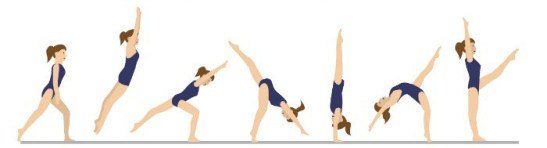
Even though front tumbling may be less scary and have a lower risk factor, it is more difficult to perform correctly. For example, a standing back handspring and back truck are fundamental skills for the developed athlete. However, standing front handsprings and front tucks are very difficult and rarely performed. Most front tumbling skills, with the exception of the front limbers and walk-overs, require a certain amount of momentum in performing the skill.  Front handsprings, front aerials, and front somersaults all are typically performed with a run, hurdle prior to the skill.

Why is front tumbling so much more difficult? In my opinion, it is technically more complex and requires stronger body control and effort to accomplish. It may not be as scary, but it is more difficult to learn correctly.  For the skills to be performed correctly, the athletes must have acquired the correct body and arm positioning to progress though the skills.  In addition to strength and aggression, flexibility also plays a major role in several of the front tumbling elements.  For example, the front limbers, walk-overs, and front aerials require a great deal flexibility in the back and shoulders.

acro front walkover

Many athletes are simply born with this trait, but many others must work years to develop the type of flexibility required in these skills (Flexibility: A Benefit to Success).  I myself struggled with flexibility as it did not come naturally.  It took me many years to learn the splits and my back flexibility was never great.  In fact, I performed a back walk-over in a floor routine at one time and my coach told me to never do it again.  I guess it wasn’t that great!!

Front tumbling consists mostly of front walkovers, front handsprings (landing on two feet or step-out), and front somersaults of different varieties. Each industry has its own specific needs and requirements. In the gymnastics industry, the students must learn to develop the front handsprings landing on two feet. It is a required element in the compulsory routine and is necessary for connecting front somersault skills. However, in the cheer and dance industries, the front handspring is most commonly seen with a step-out.

kids on dance floor

Much of this industry difference is due to the surface used in the training and performance process. In the gymnastics and all-star cheer industry, the athletes train and perform on a spring floor. In the dance programs and cheer community and school programs, the athletes perform on a non-spring floor. The differences are almost like night and day with the two floor types.


In the cheer and dance industries, the most common front tumbling skill is the front handspring step-out or front walk-over. Not only is this a progressive skill that leads to combination passes, it is also not as physically demanding on the body upon landing. It is also more conducive for tumbling on a non-spring floor or a wood or marley floor. The front handspring step-out is a great skill to use for combination passes. The athlete can proceed to connect other skills such as multiple front handsprings, round-offs, etc.

The well-rounded tumbler will have acquired both front and back tumbling skills. Both require their own set of training drills. These drills and elements should be a part of the training curriculum, especially at the beginner levels. As in all skill development, if the basics are learned correctly, the athlete will have a much greater chance of succeeding in progressing through the more advanced skills.


Coaching, Communication, Training

Consistent Communication Brings Positive Results: Corrective Coaching

When athletes are learning new skills, it is important to learn them correctly. From the beginner to the most advanced athlete, skill training needs to be done through corrective coaching. So, what is corrective coaching? It is the manner in which the coach communicates to the student throughout the training process. In this discussion, I will share my thoughts on the importance and consistency of Corrective Coaching.

There is much discussion on the importance of building a strong foundation of basic elements, so the athletes can progress in a positive manner (Tumbling: Importance of Building a Strong Foundation). Even the most basic elements need to be learned properly with good technique. When skills are learned with poor technique, the student will have challenges learning more advanced skills. In the sport of gymnastics and tumbling, all skills are somewhat related, so it is imperative to learn even these basic elements with proper technique.

For the student to learn the proper technique associated with each skill, the coach needs to communicate and explain the technique in detail. This communication needs to be done consistently to ensure the students are performing the skill with the correct technique at every attempt. This is how good habits are created.

If a student performs a skill with the wrong technique and they are not corrected, the student will continue to perform the skill the same way every time. Thus, creating a habit that will need to be corrected later. We all know that habits are difficult to break, and it takes time and consistency to fix these bad habits. The objective of every coach is to train the students properly, so bad habits are not created.

20180606_172240.jpg

I make it a point to try to make a correction to the student every time they perform a skill. No matter how small the correction may be, it is a process that is important for the student to understand what their body is doing while performing each skill. Through this type of communication, the students will begin to acknowledge and identify their own mistakes without being told. This can only happen if there is consistency in corrective coaching.

Of course, corrective coaching will not occur if the coach does not have the experience and knowledge of proper technique. Therefore, it is so important that the coaches are trained to instruct the skills at the level they are assigned to work with (Gymnastics: Training Your Staff). I train my staff by asking them what they saw that needs attention when a student performs a skill. A newer coach to the industry will probably not be able to recognize the mistakes. This is a great opportunity to train them on what to look for in skill development.

Since gymnastics and tumbling skills are so complex and are performed quickly, it is difficult to see every body angle and movement. The experienced coach has a trained eye to spot these mistakes, and this is what newer coaches must learn as well.

It is not uncommon to see students in a class where they are attempting their skills with no corrective instruction. It is difficult for a coach running a class with numerous students that are rotated through several stations. The problem we see with this structure is the coach is not able to watch every student as they rotate through the stations. As the coach is working one station, the other students basically work on their own as they perform their required curriculum on the other stations. Thus, they are not being corrected on wrong technique at every attempt.

img_07389108201424930775532.jpg

It is this scenario that brings to light the importance of class structure and controlled student to coach ratio’s. If the students are to learn in a constructive and productive environment, the class structure should be defined and completely controlled (Class Structure). In addition, the coach of each class needs to have the knowledge to not only know the technique of the skills, but to know how to run a productive class.

Training, training, training!! Not only for the students, but for the coaches as well. A well-trained coach in skill development and class management will have the tools to create and develop good athletes. In addition to the students learning their skills properly they will also be learning them safely. This creates an environment where the students can thrive and pursue their dreams and goals.

Athletes, Coaching, Evaluation, Training

Student Evaluations: Where to Place New Student Athletes

20180509_163503.jpg

There are many sports that place their athletes in particular groups based on the age of the student. We see this in sports such as football, baseball, and other such team related sports. This is to ensure an even playing field among the athletes. However, there are other sports where placement of the students is based on experience and skill level. This is common in sports like gymnastics, cheerleading, and dance. It is important to evaluate and place new students in the appropriate level so they can be in an environment that can maximize their potential.

youth football team

Proper placement for students in any group setting is a critical issue that needs to be considered. There are a number of factors that should be recognized in placement practices. Most importantly is the social environment created in group settings. It is this reason that most sports use age as the criteria for placement. Grade levels in most school systems are based on age. People at all ages tend to feel most comfortable with other people in their age range. For example, it can be extremely awkward for a teenager to be placed in a group of 5 and 6 year olds. It is the same for adults as well. Although an adult usually has the maturity to adjust to almost any environment, it still may be somewhat awkward if the age range is extremely different.

Children are very vulnerable to their social environment and it should be a major objective for the coaches and parents to ensure the child is placed in an environment where they will feel comfortable and thrive. In the sports of gymnastics, cheer, and dance, this scenario becomes challenging at times. If the student has little or no prior experience in the sport, they would certainly be considered a beginner. In many programs, beginner students are much younger, usually falling in the 5 to 7 year old age range. Students of these ages usually will get along well together in a group environment. As the students progress, they may be moved up to the next level. This mobility is relative to the ages participating at each developmental level. However, as sports increase in skill levels, the age ranges tend to expand and this can be a challenge for many programs.

FB_IMG_1521642684854.jpg

A common scenario is when a student categorized as a preschooler, for example 3 or 4 year olds, that has excelled to a higher level than what is structured for that age group. In this case, the student should be place in a higher level group so they can maximize their growth and ability. Although this placement may become necessary, it places the student in a group of students much older. When we place a 4-year-old in a group of students that are 6 to 8 years old, it may create a strong feeling of anxiety for the student.  In addition, skill levels may be much different than the maturity levels within a group.

This situation occurred in my program recently.  We have a 5-year-old student who has developed quickly and needs to be challenged at a higher level.  We placed this student in the next level up, however, the students where much older.  This was a disaster!!  The 5-year-old was so intimidated being among (giants) that she completely lost all interest in the class and sat out.  We determined it is best to move her back to her original class and the coaches will work her at a higher skill level.  Upon maturity, she will grow and be able to handle an older age division.

In addition, not only is the maturity level a huge difference, the social environment and attitudes are also different. Topics of discussion are very different among different age groups and the coaching staff needs to make sure that any discussion is appropriate, especially for the younger students in class (although there should not be much discussion among the students while in class:)

cheerleading group with young one   In the sport of cheerleading, it is very common to have a large range of ages among participants within a same squad. Due to the dynamics of this sport, students that are the “fliers” are, in many cases, smaller and much younger than the other students on the squad. We often see young elementary age students on the same team as middle school students. The age ranges can be as much as 5 or more years difference. Many people may wonder if this is appropriate. It certainly may not be a positive or appropriate environment for an 8-year-old to interact with a group of teenagers. This is where the coaching staff is challenged. Although it is difficult to monitor, the coaches should communicate to the students that conversations be limited to protect the younger students from inappropriate influences.

Another challenge that is common in most programs is when an older student with little or no experience needs to be placed in a beginner class. As mentioned earlier, most beginner students are early elementary school age. When we get a teenager wanting to learn gymnastics, it certainly can be an awkward situation to place them in a group of such young children. It may not only be awkward for the older student but also for the younger ones as well. So, what can be done? Possibly, through a trial class to see how the dynamics work in this situation. In many cases, it works out fine. In other cases, it is usually the older student who feels the most uncomfortable. One option is to offer private lessons to the older student to get them to a level where they can be placed with older students.

Some programs are large enough to have classes based on ages. For example, a program may offer classes for middle and high school students. Although, the ability and experience levels may be drastically different, the dynamics and environment are more positive for the students.

parent conference animWhat are the criteria for student placement in a program? All gyms are different in regard to their structure and class curriculum. When a new student is interested in signing up, it is important that the student is evaluated. We do this by communicating to the parent some general questions regarding skill level. For example, we may ask if the student has had experience and for how long. Questions should also be asked in regard to specific skills: can they do a great cartwheel or round-off? However, it is important to not allow the parent to dictate where a student should be placed (Coaching the Parents). We see this scenario often. Some parents may say their child is at a certain level or able to do particular skill, but when they participate in the class for the first time, the story is completely different.

I great way to evaluate the student is to offer a free trial class. Through initial conversation with the parent, the coach will have an idea of what may be the best level to start. It is better to place a student in a group for their trial class that may be under their ability level. This is to protect the student from embarrassment. I have seen students placed in a higher level than their own ability for a trail class that has resulted in embarrassment and humiliation. Sometimes to the point where they won’t come back. It is important to try to create a positive and exciting environment for all new students.

Evaluations are an important element to the success of every program.  All students are different in many ways and should be placed in a system where they can thrive and have a great experience.  A trial class or trial period is essential for the coaching staff to determine what is best for the child and the overall program.  Most importantly, the coaching staff needs to make the final decision of where the student needs to be placed.  In the proper environment, students will have a much greater chance to grow and achieve success.

showcase medal ceremony


Coaching, Dance, Safety, Training, Tumbling

Acquiring Tumbling Skills in the Dance Industry: Tumbling and the Dancer

dancer handstand

We have mentioned many times of how the sport of tumbling has become a requirement in sports. Of course, tumbling is a major part of gymnastics and cheerleading, but the requirements in Dance is growing rapidly. Each sports discipline has its own specific requirements for tumbling exercises. The skills that are popular in each sport varies. In this discussion, I will share my thoughts on how the sport of tumbling is incorporated in the dance industry.

There are several different types of dance disciplines that the dancer can participate in: jazz, lyrical, ballet, and more, but one discipline that is not seen as often is Acro. In the acro discipline, students combine tumbling skills into the dance choreography. These skills can range from very basic tumbling movements to more complex and advanced skills. The more advanced the dance student, the more advanced the tumbling elements. One of the biggest challenges for many dancers and dance programs needing to incorporate tumbling skills is proper training and development of these skills.

All disciplines of dance are very complex and students must commit many hours each week to develop the skills required in dance elements. In addition, many dancers on Company participate in several dance disciplines. Similar to gymnastics where the athletes participate in all the events, dancers may participate in Jazz, Lyrical, Ballet, Hip Hop, and more. This leaves little time for training the necessary tumbling skills the students would like to learn. The problem many dancers are faced with is that acquiring tumbling skills also takes many hours of consistent training to develop the skills (Tumbling: Importance of Building a Strong Foundation).

dancer back walkover

In the dance industry, the tumbling skills that are most popular are the front and back walkovers, front handsprings, aerial cartwheels, front aerials, and back handsprings. There are other skills that are seen but these are usually the major focus. The aerials and handsprings are considered the more advanced skills. These skills have a higher risk factor and takes, in most cases, years to accomplish.

dancer arial 2

Not only are tumbling skills required in the discipline of Acro, many of the other disciplines of dance are incorporating tumbling elements within their choreography. It seems the popularity of performing these tumbling skills is growing in the dance industry. This requires a higher demand of training to learn the skills that the students need to incorporate in their training schedule. Finding the time to train these skills is a big challenge for the students and program. In addition, most dance studio’s are also challenged with finding experienced tumbling instructors to train the students.

Since tumbling is not the primary objective in the dance industry, most dance studio’s have a challenge in hiring a full-time tumbling instructor for their program. This makes it difficult in finding a qualified instructor to commit to working with the program for the little hours allowed for this training. I am often asked by local dance programs to assist with training their students on a weekly basis. However, since my full time position is running my own gymnastics and tumbling programs, I simply to not have the time to accommodate them. This is the same scenario for many of the gymnastics and tumbling instructors in local communities.

coach spotting dancer      For those dance programs who are challenged with acquiring a tumbling instructor, there are several options they can explore. One option is to bring in an instructor periodically to do tumbling clinics for the students. There are many tumbling coaches throughout most communities that are employed at local gymnastics programs that would love to assist in this area. Another option is to have the dancers either join a weekly tumbling class at a gymnastics gym or explore one-on-one private lessons.

The most important reason to seek out professional and experienced tumbling coaches is due to the risks involved with learning tumbling skills. An experienced tumbling coach knows the proper technique of the skills and the particular drills used to assist the athlete with learning the skills in a non-threatening or dangerous manner (The Technique Controversy).

In addition to learning the skills properly, spotting the skills is essential to help the athlete gain confidence and protection from injury. This is especially important in learning the aerials and back handsprings (The Art of Spotting). Many times when athletes attempt these skills without an experienced spotter, while still in the developmental stages of learning the skill, accidents may occur. The result could create such a fear, the athlete may get a serious “mental block”. When this occurs, it may take a long time to overcome – and some athletes will never overcome the block. This scenario needs to be recognized so it can be prevented.

dancer handstand 2

One big difference the dance industry has compared to the other sports that incorporate tumbling, is that the dancers need to perform their skills on a wood or Marley surface. No matting is allowed. This certainly creates a higher risk to the dancer and intensifies the fear factor. This landing surface is much harder than the typical tumbling mats used in other industries. Not only is it a much harder surface, it can also be a slippery surface. It is needed for dancers to spin and pirouette, but creates a challenge for tumbling skills. This is another reason why the dancer needs to have their tumbling skills perfected prior to attempting on this type of surface.

We are getting an increased number of dance students either join our tumbling classes or taking private training lessons. Due to this increase in dance participants, we have started offering monthly Aerial clinics. These have been so popular that we usually reach capacity. The most common statement I hear from the dance parents is that their dance studio does not have the proper instruction to teach tumbling skills. Many dance programs that offer an acro class has an instructor but they lack the knowledge and experience in technique and spotting of the skills.

IMG_1177.JPG

It is exciting to see tumbling skills incorporated in dance choreography. Many of the skills like the walkovers and aerials are elegant in their presentation and fits well within the dance routines. Let’s ensure the students learn these skills properly and safely. Through good technique, tumbling skills add a positive dynamic to the program. However, if the skills are performed poorly with bad technique, it will certainly have a negative effect in the presentation.

Please let me know what you think on this subject. Also, if there are any subjects you would like me to cover, let me know and I will do my best to post my thoughts.  Please Like and Share to all you believe will benefit from the information.

If you would like me put on a special clinic for your program, please contact me at the information below. 

For clinics, seminars, or special events, please contact me at:  scottjohnsongymnastics@gmail.com       http://www.scottjohnsonstga.com

_TNG PNG Logo No Border

Coaching, Program Development, Skill Development, Training, Tumbling

Basics of Tumbling – From the Beginning

cartwheel on beach

Tumbling is seen and used in many activities in our society. Not only is it a competitive sport on its own but it is required as part of many other sports. It is needed in gymnastics, cheerleading, dance, martial arts, parkour, and others. It is, for most students, the most difficult of all activities to achieve. As with learning any type of activity, it is important to learn from the beginning. In this discussion, I will share my thoughts and experience in training the Basics of Tumbling.

The sport of tumbling is beneficial in many ways for enhancing performance in many activities. Not only is it the foundation in the sport of gymnastics, but it creates over-all physical development that will benefit the athlete in many areas. It teaches the athlete to be flexible, strong in all areas of the body, fast and physically explosive, coordination of motion, and much more. All these attributes are important for the success in most physical activities and sports.

As mentioned earlier, tumbling is one of the most difficult activities to learn. It is very complex and detailed. In addition, there is a certain amount of risks involved that must be acknowledged in skill development. Here, I will discuss the initial steps to consider in tumbling skill development.

As with most sports and activities, tumbling is a progressive sport meaning that each skill learned is a building block to learning the next skill. If the initial skills learned are not learned properly, the student will struggle with learning additional more advanced skills. The 3 major elements of tumbling are learning movements going forward, backward, and twisting. In this discussion, I will focus on the forward and backward tumbling elements. The twisting elements will be discussed in a following post.

Forward Tumbling;

20180716_182549.jpg

It is important to begin the development of tumbling skills from the most basic of elements. In forward tumbling, this starts with the forward roll. This fundamental skill is the beginnings of teaching the student to flip the body in a forward motion. Even this basic skill has a technique value that must be considered for accomplishment and safety. The forward roll may seem very simple and it is for many students. However, I have seen students struggle with this most basic element. Even this skill may need the assistance of a coach to spot the athlete to prevent any stress or injury to the neck or head.


straddle forward rolls

A variation of the forward roll is the straddle forward roll. This skill is very similar but more challenging as it entails more flexibility and strength. The bigger the straddle position, the easier it is for the student to push the bottom up for the roll. For this reason, a good stretching program should be the start of each training session. Again, this skill will, for most athletes, require a spot from a qualified coach.

With the successful development of these skills the student should be ready to learn the more aggressive front tumbling skills such as handstand, front limbers, walk-overs, front-handsprings and front flips – in that order. There are many drills in teaching each of these elements which will be discussed in future posts.

Note: The Bridge and Handstand are very important elements for both forward and backward tumbling that must be incorporated in each training session. Before these more advanced skills are trained, the student must have experience in these elements as many tumbling skills have these positions incorporated within the skill.

Backward Tumbling:

20180716_185811.jpg

Backward tumbling is more popular in this sport and one that is used most often in related sports. It also carries a higher risk factor which needs to be recognized. The initial fundamental skill to teach is the backward roll. This skill carries a higher risk factor than the forward roll. The back roll teaches the student the sensation of going backwards which is an unnatural motion in general movement.

20180714_093544.jpg

There are several methods used to teach this skill and both should require the coach to spot initially. Since there is body weight forced on the neck and head in performing this skill, the risk for an injury is common. All students learning this skill for the first time should have a coaches assistance. The coach needs to spot the skill by holding onto the hips and lift up as the student rolls back. This takes pressure off the neck. The two basic tools used to teach this skill is the wedge mat or two panel mats placed in a “V” position (this latter method is great for preschoolers and young ones).

The progressive skills following the backward rolls are generally: Back extension rolls, back limbers and walk-overs, back handsprings, back flips and it’s variations. These more advanced skills may take years for a student to develop. Not only is the technique in these skills more complicated, there is a strong emotional factor to consider. Due to the risk factors involved, students need to acquire a strong sense of confidence and mental strength.

The forward and backward rolls are not only fundamental requirements, but it teaches the student the awareness if flipping forward and backward which they will learn in future development. When the students acquire a strong foundation of basic elements, the time it takes to learn the more advanced skills may be faster than a student who skips these fundamental steps.


scott spotting bhsp

It is common to have students who have not learned these basic elements struggle with learning the more advanced skills that their sport requires. Cheerleaders and dancers, for example, reach a level in their sport that require such skills. These may be the back walkovers, round-offs, aerials, and front and back handsprings. Without the development of basic training in tumbling skills, the athlete will more than likely struggle in their tumbling development.

As with any activity that is built upon progressive development, it is important to not skip steps along the way. Just as in our education system, students start off learning the basic methods of math such as adding and subtracting. Once this is understood, the student can progress to algebra, geometry, and more. It would be impossible for most students to be place and succeed in an algebra class without having the knowledge of simple math skills. The same applies to tumbling and other activities.


IMG_0913.JPG

Many tumbling coaches, including myself, are happy to assist these programs. I have attended many cheer and dance programs doing clinics and classes for their athletes. I respect the owners and head coaches of these program to seek out experts in this field to help their programs. Those programs who attempt to teach tumbling skills without the proper knowledge and experienced are putting their athletes in danger. The results will more than likely be negative and the program will suffer its consequences.

Program owners and coaches who need to have their athletes trained to perform tumbling skills need to understand the importance of proper development and technique. Especially for those programs where tumbling is not a regular part of their program.  Tumbling can be a fun and exciting part of any activity, but it needs to be introduced and trained in a manner that is positive and safe for the athlete.  Let’s make it a great experience!!

Tumble-Side by Side PNG

I would love to hear your comments on this post and get your thoughts.  Please Like and Share to all you believe will benefit from the information.

For clinics, seminars, or special events, please contact me at: scottjohnsongymnastics@gmail.com             http://www.scottjohnsonstga.com

_TNG PNG Logo No Border