Skill Development

Training the Beginner Student


FB_IMG_1521642684854.jpg

All athletes begin their journey as a novice, the great ones usually with an abundance of drive to achieve and raw talent.  With that said, we all go through different levels of motor skill ability at different points in our life influenced by our mental and physical maturity.   For example, a teenager joining a track team for the first time can probably already run.  But to become an efficient runner, they will need coaching to improve their technique.  Whereas, an 8 month old child will need help developing even basic motor skills an adult would consider simple, like walking.  To the beginner, tumbling skills that involve somersaults and cartwheels that will turn them upside down is fun, but presents a whole new level motor movement.  We often see this ability gap in young children when they enter a gymnastics program. In this discussion, I will focus on the approach and training methods we use for the beginner gymnast and tumbler.

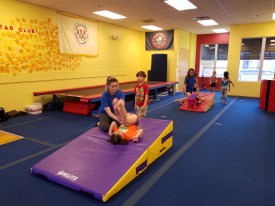
For each level of participation in our gymnastics and tumbling classes, we strictly follow a training schedule and format. For the beginning classes, the skills are very basic and much attention is spent on developing body shapes and awareness. The format we use for this level is entirely different from our preschool class program. It is at this level the instructors introduce the concept of gymnastics and tumbling that will hopefully get the student excited about moving forward in learning their basic skills. The environment should be extremely interactive, positive, and fun for the student, but not a playground atmosphere. The first class a student participates in will be, in many cases, the determining factor of whether the student will stay with the program. Classes should always be a positive and motivational experience leaving the student excited to come back.

We start our beginner classes with students at least 5 years old. We base this on maturity, not skill level. The curriculum and structure at this level is more advanced physically and emotionally than a typical preschooler would have. However, there are always exceptions where a 4-year-old is mature enough to handle this type of structure, especially if they have had been involved in a preschool gymnastics program previously.

20180403_171902.jpg

The term “beginner” refers to those students who have very little or no experience with gymnastics or tumbling. When we question parents for placement in our program, we usually ask, “can your child do a cartwheel?”. This is a very fundamental skill and one that most children want to explore, so a good question for exploration. If the answer is “no”, the child will certainly start at a beginner level. However, there is always the parent who states one thing and the truth is something very different. We, like most gyms, always offer a free trial class.   This is not only for us to evaluate the child, but also for the child to determine if the experience meets their expectations. Most importantly for the parent, will the activity be a positive learning environment for their child to succeed.

It is never a good idea for the coach or owner to allow a parent to determine where their child needs to be placed in a program. This is a common occurrence and needs to be addressed in a sensitive manner. One challenge, common in almost all programs, is having a beginner student that is much older than the other children in the class.  The difference in the age generation often is uncomfortable for the younger ones in the class, as well as the older student. In some cases, this situation is not a concern and the class flow is normal, but in other cases I have seen, it is awkward and the older student phases out of the program quickly.

20170220_181917.jpg

In gymnastics, as in all youth sports, the entry-level should be a priority initiative in order to retain students and grow the program. The beginner level of sports is the most important and delicate level to manage.  This is the introduction to the sport establishing a foundation that may very well influence the child’s passion to make it a life time pursuit.   We want to provide a great experience so the students will stay and progress within the gym. This is why the coaching staff at this level needs to be experience with not only skill development, but have a love, understanding, and patience of students in this age group. This is where trust is established between the student and coach and will set a precedence in the mind of the student moving forward. For this reason, the instructors need to be more interactive and hands-on at this level than any other. The students are not mature enough to train alone without constant supervision and physical interaction like the older more advanced recreational or team students.

FB_IMG_1521986299223.jpg

As someone who has coached team level gymnastics at all levels, I have found that the dynamics of coaching at the lower non-competitive levels has entirely different rules and objectives. It did not take me long to learn how important it was to create a structure and environment that will have a lasting effect on these students. I get a great deal of satisfaction working with these young students and seeing the gleam in their eyes when learning something for the first time and watching a few grow to be champions later in their development. The influence we have on these students can determine the success or failure in future growth. Let’s make it successful!!

If you have questions, do not hesitate to comment or send me a message. Also, if there are any subjects you would like me to cover, let me know and I will do my best to post my thoughts. As always, I would love to hear your comments. Please Like and Share to all you believe will benefit from the information.

For clinics, seminars, or special events, please contact me at: scottjohnsongymnastics@gmail.com

Program Development, Uncategorized

Class Structure

Tumble-Side by Side PNG

There are many factors that go into creating a successful program and successful athletes. Some of these factors include proper staffing, proper equipment, great management and communication skills as well as many more which will be discussed in future posts. In this discussion, I will be focusing on the importance of Class Structure as it relates to recreational programs.

Depending on the type of gym, whether it is a gymnastics, cheer, dance, or other, the class structures may be quite diverse. There are classes for each skill level, classes for different age groups, classes for rec students, classes for competitive students, and many more types of classes that are needed to meet the community’s needs and help the gym grow. Thus, class structures must be well-defined and can get quite extensive.

WS group in seal stretch

All gym owners and program directors have their own opinions and views of how they should structure their class programs. There is a lot of information out there regarding this subject and it can be very diverse in application. What this means is that there is no “set in stone” structure or system that will guarantee positive results. Every program is different and program objectives may be different. So, the class structures in each program must be designed to meet the goals and objectives of the gym.

preschool stretch

However, there are a few guidelines that, I believe, are essential in setting up the class structure. Most recreational programs have a class time of approximately 55 minutes. Preschool classes are usually a shorter time frame as these little ones have such a short attention span (some have zero:) Through my years of working these rec classes, I have found that the structure must me laid out so the students are engaged and working productively throughout the entire class time. To accomplish this, there are several issues to consider.

parents viewing

Have you ever heard of a scenario where the parents, who are observing the class, watch the clock closely and even take notes on how often their child takes a turn on a piece of equipment? I have heard this issue for many years and have found that this one issue plays a major role in the retention of students. Why does this happen? There are a number of issues that contribute to this problem: too many students per class, not enough stations, lack of traffic control, inexperienced coaches. Each of these factors can be fixed to ensure the class program’s success.

As a gym owner, we all want to maximize the number of students in our programs in order to maximize the revenue. Although this is a critical issue, it is important to weigh the financial picture with the quality picture. Today, there are many activity options where parents can enroll their children. We have all heard of “gym hoppers” where some parents always think the grass is greener at another location. This is not usually the case, but has some merit if a program is not meeting the parent’s quality expectations.

Parents are consumers just like you and I. When they pay for something, whether it’s a product or a service, they are going to have both real and perceived expectations. Hence, if they don’t see a positive return for what they are paying for, you may very well lose the student.

20180312_183426.jpg

I believe it is very difficult for one coach to run a class of more than 8 or 9 students. Even with numerous stations set up for the class, the instructor would have a hard time watching all the students and making the proper corrections throughout the class. Class sizes that exceed this number should have an additional coach. As I discussed in a previous post (Coaching: The Communication Factor), it is important that the instructor communicates on a consistent basis so the students always understand the skill development corrections they are given. In addition to this being a quality issue, it is also a safety issue. Each child, especially the younger student’s, need to be watched closely throughout the class period. While the class is being run, the instructor must be placed in a position where all the students can be seen. No student should be working at a station where the coach cannot see them.

A 55 minute class can fly by in flash, so the class should be structured in accordance to time frames. Always start the class on time- this is critical!! The stretch should have a time limit, each skill being worked or station rotation should have a time limit. If the clock is being monitored closely, the students should be able to work through the 55 minute curriculum and accomplish the program effectively.

two handstands in gym

A successful program is one that develops the students in a progressive manner in all levels of participation. This requires that each instructor of every class is trained and has the knowledge and experience to run a successful class. If parents are not seeing any progress over a period of time, they will seek other programs or activities for their children. With this being said, however, not every student is made for the type of program you are offering and may not progress regardless of the structure being offered. All we can do is provide 100% effort to insure the students get the best possible instruction.

Change should always be considered as well. Program objectives may change, student dynamics may change, etc. In every case, class structures should stay up to date with these changes. I personally have gone through many structure scenarios to find the perfect fit for my program objectives. I do my best to stick with a consistent program so the students can progress and accomplish their skills as quickly as possible. I will cover the subject of class curriculum in another post.

20160608_110312

Remember, if the program is a positive program with positive instructors and an exciting and positive environment, the participants will be more likely to love what they are doing and have the motivation to move forward in their development.

I would love to hear your feedback on this issue and answer any questions you may have. You can contact me through this post, or FB, Twitter, or my email at: scottjohnsongymnastics@gmail.com

Be sure to like this post and share to all you believe will benefit from its content. There will be lots more to follow!!

two on smarter spotter

Communication, Uncategorized

Coaching: The Communication Factor

coach and athletes

Have you ever been to a seminar, clinic, or special event to listen to a speaker or series of speakers talking about issues involving their particular industries? If so, have their been instances where you didn’t understand what the speaker was talking about? How about in the gymnastics or other sports industries where you listen to experts talk about technical issues or skill development and the content is difficult to understand? This is not uncommon and I personally have experienced these problems.

In this discussion, I will focus on the importance of communicating in a way that your audience will understand and take away priceless knowledge that will help with improvement and growth.

Preschool group stretch

There are many different levels of activity in every type of sport and each level has it’s own set of rules, training methods, and curriculum. These levels range from beginners through the most advanced. No matter what the level of group the coach is working with, it is critical that the coach is communicating to that particular group in a way that the students can understand. For example, a coach would not want to talk to an advanced group of older athletes as if they were pre-schoolers and vise versa.

Since the sports of gymnastics and tumbling is so complex in skill development, the coaches need to have the knowledge that is appropriate for coaching their particular level. This is so important for the positive growth of each student. But what may be even more important is how that coach communicates to the student. What may make sense to the coach in teaching a skill or making a correction may not make any sense to the athlete.

coach with athlete

For those coaches out there, how often have you made numerous statements to a student to correct a problem and the student has not make the correction? Frustrating isn’t it?!! Even simple corrections, like straightening of the legs, or arching of the back? What I have found over the years, is that in many cases, the student has no idea what your talking about. How do you find out? You ask them if they know what you mean. You’ll be amazed at how many will say “No”. If I have a student that is bending their legs on a cartwheel I will often ask them, “do you feel your legs bending?” Often they will say no. It’s then I realized that it is important to communicate that they need to focus on that one particular issue in order to fix it. If they can feel their legs bending eventually they will be able to make the correction to straighten their legs. It is only then that the coach can communicate in a different manner, break the skill down, and explain in a way that the student will understand. With this new understanding, the student can begin to make the correction. This is why it is so critical that the coach has the knowledge to teach the skills they are teaching.

Fixing bad habits is a constant struggle for many coaches, especially on the recreational side of sports. We get new students from other programs that were not taught correctly or students who are self taught. How are habits made? Consistency. The coaches objective is to change from a bad habit to a good habit. How? Again, Consistency. Coaches need to make the correction every time the student performs the skill. I have seen often, in programs I have visited, coaches having their students go through their curriculum and workout with little verbal communication to the students. This allows the student to consistently perform their skills in the same manner every time- thus reinforcing bad habits.

Scott coaching Kailyn

I make it a priority to instruct my staff to make a comment each time a student performs a skill. Whether it is a correction or a praise in their performance. We never communicate in a threatening, deeming, or negative manner. Our communication is always based on being positive and providing constructive criticism in making corrections. Students should never be yelled at, called out, or treated in a negative way. My philosophy has always been: If you love what you are doing, hard work becomes easy and you will naturally be motivated to improve yourself. We want to create the most positive environment for our students. If this is accomplished, the students will more likely stay with the program and take their ability as far as they can go.