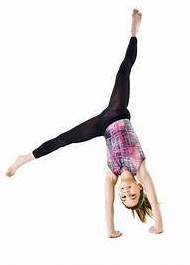
Front Tumbling, Skill Development, Training, Tumbling

The Difference Between Forward and Backward Tumbling Skills: The Dynamics of Front Tumbling

dancer back walkover

The most common and most performed tumbling skills in sports that entail tumbling as part of their structure is back tumbling. This includes back handsprings and the many varieties of backward somersaults. Although front tumbling has grown as a major element in the gymnastics industry, it is not used as often in the cheer and dance industries. Front tumbling has an entirely different dynamic than back tumbling – and it is considered by many to be more difficult. In this discussion, I will share my thoughts on the dynamics, training, and development of front tumbling skills.

coach spotting dancer

Just as in back tumbling skills, front tumbling skills also build from a foundation of basic elements. Developing great technique in the basic elements of front tumbling, such as the forward rolls, handstands, front limbers and walkovers, will allow the students to progress more easily to the more difficult skills (Basics of Tumbling – From the Beginning).

One major difference between front and back tumbling is the emotional factors involved in each. For most athletes, front tumbling does not carry the same fear factor as back tumbling. Since we are accustomed to move in a forward motion throughout almost every activity, it is more natural and comfortable to move in this direction.

I have trained and worked with many athletes who are simply afraid to go backwards. Even through basic development, going backward is “scary” for many. It is rare to find an athlete with a mental block of tumbling forward, but very common in back tumbling. There is certainly a higher risk factor in back tumbling and, if not developed in a safe and experienced environment, accidents and injury can occur (Confidence and the Mental Block). This is, in most cases, the reason why mental blocks are created.
how-to-do-a-front-handspring anim

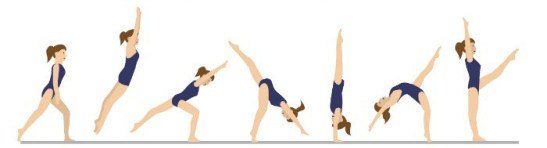
Even though front tumbling may be less scary and have a lower risk factor, it is more difficult to perform correctly. For example, a standing back handspring and back truck are fundamental skills for the developed athlete. However, standing front handsprings and front tucks are very difficult and rarely performed. Most front tumbling skills, with the exception of the front limbers and walk-overs, require a certain amount of momentum in performing the skill.  Front handsprings, front aerials, and front somersaults all are typically performed with a run, hurdle prior to the skill.

Why is front tumbling so much more difficult? In my opinion, it is technically more complex and requires stronger body control and effort to accomplish. It may not be as scary, but it is more difficult to learn correctly.  For the skills to be performed correctly, the athletes must have acquired the correct body and arm positioning to progress though the skills.  In addition to strength and aggression, flexibility also plays a major role in several of the front tumbling elements.  For example, the front limbers, walk-overs, and front aerials require a great deal flexibility in the back and shoulders.

acro front walkover

Many athletes are simply born with this trait, but many others must work years to develop the type of flexibility required in these skills (Flexibility: A Benefit to Success).  I myself struggled with flexibility as it did not come naturally.  It took me many years to learn the splits and my back flexibility was never great.  In fact, I performed a back walk-over in a floor routine at one time and my coach told me to never do it again.  I guess it wasn’t that great!!

Front tumbling consists mostly of front walkovers, front handsprings (landing on two feet or step-out), and front somersaults of different varieties. Each industry has its own specific needs and requirements. In the gymnastics industry, the students must learn to develop the front handsprings landing on two feet. It is a required element in the compulsory routine and is necessary for connecting front somersault skills. However, in the cheer and dance industries, the front handspring is most commonly seen with a step-out.

kids on dance floor

Much of this industry difference is due to the surface used in the training and performance process. In the gymnastics and all-star cheer industry, the athletes train and perform on a spring floor. In the dance programs and cheer community and school programs, the athletes perform on a non-spring floor. The differences are almost like night and day with the two floor types.


In the cheer and dance industries, the most common front tumbling skill is the front handspring step-out or front walk-over. Not only is this a progressive skill that leads to combination passes, it is also not as physically demanding on the body upon landing. It is also more conducive for tumbling on a non-spring floor or a wood or marley floor. The front handspring step-out is a great skill to use for combination passes. The athlete can proceed to connect other skills such as multiple front handsprings, round-offs, etc.

The well-rounded tumbler will have acquired both front and back tumbling skills. Both require their own set of training drills. These drills and elements should be a part of the training curriculum, especially at the beginner levels. As in all skill development, if the basics are learned correctly, the athlete will have a much greater chance of succeeding in progressing through the more advanced skills.


Cheerleading and Tumbling, Gymnastics, Skill Development, Tumbling, Twisting

Preparing the Athlete on Advanced Movement: The Twisting Element


Cheer Full

In sports that entail acrobatic skills such as gymnastics, cheerleading, dance, diving, ski jumping, and more, the ultimate objective for the athletes is to learn skills that have both flipping and twisting elements. These skills are highly advanced and requires that the athlete has learned basic skills with great technique. In this discussion, I will take you through my thoughts on the development stages of learning to twist in tumbling skills.

As the students progress through the developmental stages of learning to tumble forward and backward, the next step is to learn how to incorporate twisting movements. These skills are much more complex and requires that the athletes have proper technique in their developmental skills in order to accomplish these twisting elements.

Shadow twisting

Body positioning and control is critical in allowing the athlete to twist while the body is in a forward or backward flipping motion. For example, to spin a pencil on its end is an easy task as the pencil is a solid, straight object. However, it is impossible to spin a shoe string as there is no solid control of the object. The same with our bodies, if the student has loose and limp body movements, it will be very challenging or impossible to twist. This is the reason why body position and body tightness is a major focus in training all skills.

I consider the cartwheel to be the initial movement learned that relates to twisting skills. A critical key to acknowledge, which is commonly overlooked, is to determine which direction the student needs to perform the skill. Why? because this is the direction that should be consistent throughout the entire lifetime of progressive skill development. So how do we determine which direction to go? It is irrelevant if the student is right hand or left hand dominate.

Cartwheel.jpgI have always believed that what ever feels most natural for the athlete is the direction they should pursue. In fact, a majority of athletes twist in the opposite direction of their dominate hand – it is more natural. Let me explain: when a right-handed person throws or kicks a ball, the body actually moves and turns to the left while performing the action. Thus, for many people, it is natural for the body to turn in this direction.

However, this rule does not apply to every athlete. When I have a beginner student learning a cartwheel for the first time, I will ask them to spin around. The direction of their spin is a good indication of what direction may come natural for them. So I have the student try this direction first. If they struggle, I have them try the other way. Trial and error seems to work best to figure out which way to go. And once it is determined, that way should stay permanent.

Once the athlete determines the direction of the cartwheel, either left or right, it is critical that all progressive skills follow the same direction. If the student is what we call a “righty” this means the right leg will lead in all skills. This includes lunge to handstands, round-offs, front walk-overs, front handsprings, etc. I have seen, on several occasions, an athlete perform their round-off with one leg leading, however, perform a front walkover and front handspring with the other leg. This will create a challenge for the student to connect tumbling elements.

Round-off anim

The round-off is the next progressive skill to learn following the cartwheel. This is a very complex element to learn and there is much discussion among coaches on the challenges of learning this skill properly. This skill must be accomplished correctly with great technique in order for the student to connect additional skills – like the back handspring. An entire post can be dedicated to this one skill.

What is the purpose of the round-off? It is the skill used to turn forward momentum into backward momentum. It is a twisting element where the body generates a half turn while in an upside down position. Some athletes catch on to this transition quickly, but others may take longer to accomplish.

It is important to recognize that whatever direction the round-off is initiated, either right or left, this is the direction the athlete needs to twist in their connected elements. When the round-off is completed, the movement of the body continues in that same direction which creates a natural smooth transition. For example, let’s look at the cartwheel on the balance beam. If the student is leading the cartwheel with the left leg, the skill will end with the left leg behind the right leg. In this position, the hips are turned slightly to the left creating a left twisting motion.

I have seen many athletes perform their round-offs in one direction and twist in another direction. Although this is not a factor that will create a barrier to excel in tumbling elements, it does have its challenges. For example, it is certainly a challenge and more difficult to learn a round-off to an Arabian front flip or a back full. Performing a back handspring in-between the skills would eliminate this transitional challenge.

drawing back full

As I mentioned earlier, in order for the body to perform a twisting motion, the body must be tight and straight. For back tumbling, this requires the athlete to have great technique in the back layout in order for the body to be able to twist. In order for this to occur, the athlete must have great technique in the round-off and back handspring. These elements set up the layout and twisting skills.

Back arch flip animThe most common problem that prevents the athlete from twisting is the arched position. If the athlete has an arched position in their layout, the twisting motion is very difficult to achieve. The body must remain in a tight and straight position for the twist to be effective.  This scenario goes back to the initial fundamental training for the athlete (Tumbling: Importance of Building a Strong Foundation).  With proper training and drills, the students have a greater chance to learn the body control needed to accomplish these skills.

We stress how important it is for the athletes to learn proper technique in all skills – starting from the most basic elements.  Since all skills in tumbling are generally related and tend to build upon another, the better the technique, the greater chance the athlete will succeed in learning the more advanced twisting tumbling skills.

ski jumper twisting

I am in the process of publishing my first training manual: “Beginner Tumbling Training”.  This will be a useful tool in training for all and any needing to learn proper technique and safety. Great for gymnastics, cheerleading, dance, martial arts, and more. I will keep you posted on that progress.

In addition, if you would like a personal training session or consultation with me, we can Skype a lesson. Private message me or email me at: scottjohnsongymnastics@gmail.com

Coaching, Program Development, Skill Development, Training, Tumbling

Basics of Tumbling – From the Beginning

cartwheel on beach

Tumbling is seen and used in many activities in our society. Not only is it a competitive sport on its own but it is required as part of many other sports. It is needed in gymnastics, cheerleading, dance, martial arts, parkour, and others. It is, for most students, the most difficult of all activities to achieve. As with learning any type of activity, it is important to learn from the beginning. In this discussion, I will share my thoughts and experience in training the Basics of Tumbling.

The sport of tumbling is beneficial in many ways for enhancing performance in many activities. Not only is it the foundation in the sport of gymnastics, but it creates over-all physical development that will benefit the athlete in many areas. It teaches the athlete to be flexible, strong in all areas of the body, fast and physically explosive, coordination of motion, and much more. All these attributes are important for the success in most physical activities and sports.

As mentioned earlier, tumbling is one of the most difficult activities to learn. It is very complex and detailed. In addition, there is a certain amount of risks involved that must be acknowledged in skill development. Here, I will discuss the initial steps to consider in tumbling skill development.

As with most sports and activities, tumbling is a progressive sport meaning that each skill learned is a building block to learning the next skill. If the initial skills learned are not learned properly, the student will struggle with learning additional more advanced skills. The 3 major elements of tumbling are learning movements going forward, backward, and twisting. In this discussion, I will focus on the forward and backward tumbling elements. The twisting elements will be discussed in a following post.

Forward Tumbling;

20180716_182549.jpg

It is important to begin the development of tumbling skills from the most basic of elements. In forward tumbling, this starts with the forward roll. This fundamental skill is the beginnings of teaching the student to flip the body in a forward motion. Even this basic skill has a technique value that must be considered for accomplishment and safety. The forward roll may seem very simple and it is for many students. However, I have seen students struggle with this most basic element. Even this skill may need the assistance of a coach to spot the athlete to prevent any stress or injury to the neck or head.


straddle forward rolls

A variation of the forward roll is the straddle forward roll. This skill is very similar but more challenging as it entails more flexibility and strength. The bigger the straddle position, the easier it is for the student to push the bottom up for the roll. For this reason, a good stretching program should be the start of each training session. Again, this skill will, for most athletes, require a spot from a qualified coach.

With the successful development of these skills the student should be ready to learn the more aggressive front tumbling skills such as handstand, front limbers, walk-overs, front-handsprings and front flips – in that order. There are many drills in teaching each of these elements which will be discussed in future posts.

Note: The Bridge and Handstand are very important elements for both forward and backward tumbling that must be incorporated in each training session. Before these more advanced skills are trained, the student must have experience in these elements as many tumbling skills have these positions incorporated within the skill.

Backward Tumbling:

20180716_185811.jpg

Backward tumbling is more popular in this sport and one that is used most often in related sports. It also carries a higher risk factor which needs to be recognized. The initial fundamental skill to teach is the backward roll. This skill carries a higher risk factor than the forward roll. The back roll teaches the student the sensation of going backwards which is an unnatural motion in general movement.

20180714_093544.jpg

There are several methods used to teach this skill and both should require the coach to spot initially. Since there is body weight forced on the neck and head in performing this skill, the risk for an injury is common. All students learning this skill for the first time should have a coaches assistance. The coach needs to spot the skill by holding onto the hips and lift up as the student rolls back. This takes pressure off the neck. The two basic tools used to teach this skill is the wedge mat or two panel mats placed in a “V” position (this latter method is great for preschoolers and young ones).

The progressive skills following the backward rolls are generally: Back extension rolls, back limbers and walk-overs, back handsprings, back flips and it’s variations. These more advanced skills may take years for a student to develop. Not only is the technique in these skills more complicated, there is a strong emotional factor to consider. Due to the risk factors involved, students need to acquire a strong sense of confidence and mental strength.

The forward and backward rolls are not only fundamental requirements, but it teaches the student the awareness if flipping forward and backward which they will learn in future development. When the students acquire a strong foundation of basic elements, the time it takes to learn the more advanced skills may be faster than a student who skips these fundamental steps.


scott spotting bhsp

It is common to have students who have not learned these basic elements struggle with learning the more advanced skills that their sport requires. Cheerleaders and dancers, for example, reach a level in their sport that require such skills. These may be the back walkovers, round-offs, aerials, and front and back handsprings. Without the development of basic training in tumbling skills, the athlete will more than likely struggle in their tumbling development.

As with any activity that is built upon progressive development, it is important to not skip steps along the way. Just as in our education system, students start off learning the basic methods of math such as adding and subtracting. Once this is understood, the student can progress to algebra, geometry, and more. It would be impossible for most students to be place and succeed in an algebra class without having the knowledge of simple math skills. The same applies to tumbling and other activities.


IMG_0913.JPG

Many tumbling coaches, including myself, are happy to assist these programs. I have attended many cheer and dance programs doing clinics and classes for their athletes. I respect the owners and head coaches of these program to seek out experts in this field to help their programs. Those programs who attempt to teach tumbling skills without the proper knowledge and experienced are putting their athletes in danger. The results will more than likely be negative and the program will suffer its consequences.

Program owners and coaches who need to have their athletes trained to perform tumbling skills need to understand the importance of proper development and technique. Especially for those programs where tumbling is not a regular part of their program.  Tumbling can be a fun and exciting part of any activity, but it needs to be introduced and trained in a manner that is positive and safe for the athlete.  Let’s make it a great experience!!

Tumble-Side by Side PNG

I would love to hear your comments on this post and get your thoughts.  Please Like and Share to all you believe will benefit from the information.

For clinics, seminars, or special events, please contact me at: scottjohnsongymnastics@gmail.com             http://www.scottjohnsonstga.com

_TNG PNG Logo No Border

Cheerleading and Tumbling, Coaching, Safety, Skill Development

Cheerleader and Tumbling

cheerleader-1581231_1920.jpg

When I decided years ago to start my recreational tumbling program, I had no idea cheerleading had mushroomed beyond sideline cheerleading into a competition sport!  I came from a gymnastics background and didn’t realize the number of athletes involved in the sport of cheerleading was huge.  When the cheer programs and cheer parents in our community had heard that I started a tumbling program, my classes filled up quickly.  What I noticed immediately was that the majority of these athletes hadn’t been taught basic tumbling mechanics and technique.  It was then that I realized that I had something to offer that would benefit their skill development as athletes to not only be better, but safer tumblers.  In this discussion, I will share my thoughts on the importance of proper skill mechanics for the cheerleader.

I posted on this subject previously but wanted to elaborate on some progressions to consider when training the cheerleader in tumbling. The sport of cheerleading has had enormous growth throughout the world and continues to grow at a rapid pace. The number of athletes involved in cheerleading today is huge. Unfortunately too many of them are rushed to be part of a competition team and never receive proper instruction in tumbling technique.

In regard to tumbling, the sports of gymnastics and cheerleading share many parallel skill dynamics. In gymnastics, beginning students are immediately immersed in fundamental technique and proper mechanics as the initial step toward the development of basic tumbling skills.  This means the students are immediately learning about the different body positions and shapes that will be vital to the development of all tumbling skills. Why the focus on such detail?  Because these same beginning mechanics and technique will be the building blocks that will allow them to acquire more advanced tumbling skills down the road.

group lunge postition

To better understand why proper technique has such high priority in gymnastics vs. cheerleading, we simply need to look at the fundamental difference between their competition formats. Cheerleading is an all inclusive team sport where the team is evaluated based on performing in unison. So if an individual members skill technique is somewhat flawed it has little impact on the overall team score. In gymnastics, the athlete competes alone and is evaluated on the technical execution of each and every skill they perform throughout the routine. Talk about being under a microscope!

With that said, the required basic tumbling elements for both sports are essentially the same (The Technique Controversy). The real priority for us as coaches and instructors should be teaching proper technique not only to advance the athlete, but more importantly to minimize the risk of injury.

I have worked with many gymnasts and cheerleaders that have developed such bad habits in their tumbling skills that they have come to a dead-end and unable to move on to more advanced skills.  For most of the cheerleaders the result is due to the rush I mentioned earlier. In too many cases the athlete and/or the coach is in such a rush to get that one series of skills that proper technique is forfeited for the sake of time. In the end, this approach will prove to be detrimental to the athlete’s ability to build on their skill level.

The underlying concern in many cheer programs is that too many beginning tumbling instructors do not always have the inherited understanding of skill development progressions gained through years of exposure as a gymnast. They may be experts in stunting and cheer choreography, but may lack the basic technical understanding of tumbling skill progression. Teaching proper tumbling skill technique is very detailed and takes time.  Fully understanding tumbling skill mechanics and drill progressions takes years of experience, education, and in most cases actually doing.

Coaches conference
Coaches Training Conference

I highly suggest that cheer programs that do not have access to qualified tumbling instructors seek out gymnastic programs that offer tumbling for cheerleaders and set up a program for both athlete’s and instructors.

I have seen FB posts of video showing students performing a skill incorrectly with the coach asking for advice.  My initial reaction in many cases has been that they are not ready for that level of skill. Admittedly, in some cases, the safety of the student has been a concern. This is an example of the instructor not fully understanding the inherent risk associated in doing the skill improperly. In regard to the athlete, performing a skill poorly is an obvious sign that they do not have an understanding of the mechanics involved in the skill. This lack of understanding can and will result in a fear of the skill possibly to the point of a mental block, and that may very well keep them from ever owning the skill.

As I said earlier in this article, the real priority for us as coaches and instructors should be teaching proper technique not only to advance the athlete, but more importantly to minimize the risk of injury.

There are many cheerleading programs out there that do have a strong and structured tumbling program within their system.  All cheer programs should develop these systems for the positive development and safety of their athletes.  There are many resources that can be found to assist these gyms in developing a strong tumbling program.  I have worked with many cheer programs doing clinics for their students and coaches.  In addition, cheer conferences and clinics are a good way for the coaching staff to learn this knowledge.  Knowledge is power and power brings success!!

animated cheerleader with pompoms

I would love to hear your comments. Also, if there are any subjects you would like me to cover, let me know and I will do my best to post my thoughts.  Please Like and Share to all you believe will benefit from the information.

For clinics, seminars, or special events, please contact me at:  scottjohnsongymnastics@gmail.com            http://www.scottjohnsonstga.com

_TNG PNG Logo No Border


Communication, Confidence, Mental Block, Mental Training, Safety, Skill Development

Confidence and the Mental Block

athlete success

There are many factors that come into play when considering what it takes to be successful.  Of course hard work, determination, motivation, sacrifice, and confidence are all major contributors in the journey to success. Unfortunately, so is the always lurking Mental Block.  In this discussion, I will share my thoughts on the role that Confidence plays in preventing and overcoming the Mental Block.

When a person is confident at what they are doing the task at hand is accomplish with ease, it gives us a feeling of security. It affects everything we do each and every day.  Confidence not only makes you feel good about yourself, it’s contagious and can even influence those around you to also be confident. A lack of confidence conversely can create fear, panic, and at times a Mental Block.

So how is confidence achieved or how does one become confident in what they are doing and trying to accomplish?  Participating in a positive and energetic environment certainly helps.  Most importantly, however, is the consistency of accomplishment.  Building confidence in something usually does not magically happen, it must be developed.  It takes time and effort in a positive environment for confidence to begin to build.  Communication and positive reinforcement from the coach is a major factor in helping to build confidence in the athlete (Coaching: The Communication Factor).  Words of encouragement and using a positive approach should always be a part of the training process.  This approach in itself is very powerful in building a strong sense of personal strength.


vollyball girl serious look

When a person is attempting an acrobatic skill that requires you to turn upside down for the first time there can be a feeling of apprehension, even fear.  This is natural, what’s unnatural is turning upside down when you’re used to walking around right side up!

In sports such as gymnastics, cheerleading, trampoline, and tumbling where athletes are learning to flip and twist there is always some level of fear that must be overcome with confidence.  When the activity involves inherent risks, the level of confidence required to minimize any fear of failure requires that both the athlete and coach fully comprehend the task at hand. Through a structured and disciplined training program, athletes are more likely to achieve the level of confidence needed that will enable them to succeed.

When a person has a lack of confidence in what they are attempting to achieve, it is an emotion that must be changed in order for the person to move forward. This is when the Mental Block comes into play.  Not only is this a very frustrating experience but one that can end a career or participation in an activity.   In addition, a lack of confidence can also result in an injury if a student is attempting something they are unsure about or scared to perform.


20180328_193239-e1523326367170.jpg

This is where the coach or instructor plays an important role.  It is the coach that trains the athlete and the one that is responsible for the development of skills.  When the coach has the knowledge of progressions and drills, it helps to guide the student to learn skills in a non-stressful environment.  This is crucial in building confidence in the athlete (The Technique Controversy).  If the student is placed in a stressful environment or forced to attempt a skill they are scared to perform, their confidence will almost assuredly be diminished.

There are two basic factors that allow one to attempt a gymnastic skill. Being able to perform the skill physically, and being able to comprehend it mentally. In most cases the ability to comprehend the skill mentally is the larger concern.

FB_IMG_1530453083848.jpg

Learning a new skill usually begins with a number of mechanical drills to mimic the body positions and motions it will go through to successfully complete the skill.  The next step may be for the coach to spot or assist the student through the skill for their safety, and for them to feel the sensation of rotation. After a period of time when the student demonstrates they can physically execute the skill safely with little or no spotting assistance the instructor may step back and allow the student to attempt the skill on their own. This is when the level of their confidence and mental state will most likely show itself. How many times have you coaches spotted back handsprings but the moment the student doesn’t feel your hand there, they will not go?  Why?  because the athlete has not developed the confidence needed to go solo – they are afraid.


Failure pic

I have worked with many students that have lost all confidence in a particular skill and developed the “Mental Block”.  Most are a result of the student attempting a skill they were not mentally ready to perform without assistance that ended badly – scaring them, or worse, resulting in an injury.  Another cause for the development of a mental block could simply be that the athlete starts to think of negative things or watching someone else take a fall or get injured doing a particular skill. Once a mental block has evolved the athlete will struggle to advance the skill further. Even worse, if the athlete cannot overcome the mental block there is even the possibility they will discontinue participating in the sport.

This is very common in almost every program and one that must be dealt with carefully.  When an athlete has lost their confidence in a skill, they should never be coerced into attempting the skill. Doing so will only serve to perpetuate the Mental Block or worse instill even greater fear. The signs are:  the student hesitates, or stalls for a lengthy period of time.  What are they thinking about?  In many cases, they are thinking about getting hurt if they fail which creates fear.  This thought process needs to be eliminated and can be accomplished through additional training.  Sometimes, it may be best for the athlete to relearn the skill from scratch and focus on drills and mechanical technique. This process takes time but in many cases, will cure the block so the athlete can continue to progress.

I have always believed that champions are created in a positive training environment. Such environments are critical in helping the students feel good about what they are doing which is a big factor in building confidence.  When an athlete has a great sense of confidence, they will be more aggressive in their training development.  The more aggressive the training, the better the chance of success!!


girl-in-the-gym


I would love to hear your comments. Also, if there are any subjects you would like me to cover, let me know and I will do my best to post my thoughts.  Please Like and Share to all you believe will benefit from the information.

For clinics, seminars, or special events, please contact me at:  scottjohnsongymnastics@gmail.com            http://www.scottjohnsonstga.com

_TNG PNG Logo No Border