Improve Weaknesses, Skill Development, Success, Training

Improving Your Weaknesses

Achieving success is not an easy task, at least for most of us. For the athlete to achieve success, it may take many years of hard work and dedication. If the goal is to become competitive and achieve success at the highest levels of competition, like the Olympic Games, the time it takes may be much longer. However, even at the elementary stages of participation, success is accomplished by focusing on one major factor: Improving Your Weaknesses.

Most successful athletes have some type of natural talent which allows them to progress quickly. However, although some parts of the sport may come easy, there are other parts of the sport that may be very challenging.

For many sports that entail several or many different physical attributes to accomplish, this is a common scenario.  For example, the sport of gymnastics has different apparatus which requires totally different physical attributes to achieve.  Tumbling, for example, has no physical relation to pommel horse in men’s gymnastics.  The same may apply to bars vs beam in women’s gymnastics or hip hop vs ballet in the  dance industry. Athlete’s may be strong in one aspect or event of the sport, but is challenged by others.

For an athlete to excel in all parts of the sport, it is imperative that a major focus should be on training and improving the weaknesses. Although this may not be as fun as working your strengths, it is necessary to achieve success. In my own personal experience with competitive gymnastics, my strengths were tumbling and the rings. Skill development was easier and more comfortable to achieve. However, my challenges were the pommel horse and high bar.

Early in my competitive career, I realized that in order to achieve my dreams and goals, I needed to excel in these challenging events. I would spend almost twice as much time training on my weak events than my stronger events. The philosophy I developed is that one must maintain their strengths and improve their weaknesses. This certainly worked for me as I was able to achieve the goals I had set and become successful in the sport.

Each athlete and coach should find the perfect training schedule designed for each athlete that maximizes their potential. There needs to be a balance within the training environment where the athlete can continue to be motivated and enjoy their experience. https://scottjohnsonsgymexperience.com/2018/05/04/setting-goals-the-path-to-success/ Please note, focusing only on weak and challenging areas can quickly create negative emotions within the athlete. This can certainly effect a person’s motivation and cause consistent frustration. The result will be a decrease in effort and could cause the athlete to quit the sport.

I always stress that training environments need to be positive. Even in challenging area’s, the training atmosphere should maintain a positive experience. It’s not easy to become a champion. It takes a lot of hard work and consistent motivation. Maintain Your Strengths and Improve Your Weaknesses.

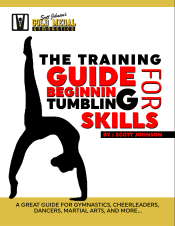
I am in the process of publishing my first training manual: “Beginner Tumbling Training” .  This will be a useful tool in training for all and any needing to learn proper technique and safety. Great for gymnastics, cheerleading, dance, martial arts, and more. I will keep you posted on that progress.

In addition, if you would like a personal training session or consultation with me, we can Skype a lesson. Private message me or email me at: scottjohnsongymnastics@gmail.com


Athletes, Coaching, Injuries, Round-Off, Safety, Skill Development

Tumbling: Wrist and Ankle Pain

Does your student or child have consistent wrist and/or ankle pain when training their tumbling skills? This is a very common problem and one that can be be fixed through proper training. In most cases, it is due to poor technique in performing tumbling skills. If the technique is improved, it will result in much less stress on the body and joints.

We often see athletes wearing supports for wrists, ankles, and knees. There is no doubt that the sport if gymnastics and tumbling creates stress on the joints: Injuries: Prevention and Repair. These support braces will help with discomfort and provide added support while performing skills. However, the athlete should not rely on these braces for extended periods of time. The objective should be to heal and strengthen the area. If the braces are worn consistently, the area will not strengthen adequately, thus creating a dependence on the brace.

In the case of wrist discomfort, much of the cause may be poor technique in performing skills. One example is the hand placement on cartwheels and round-offs.

When performing these skills, the student should turn their second hand so the fingers are facing toward the first hand when placing on the floor. Not only will this allow the student to push or block off the floor for an adequate finish of the skill, it is the correct positioning of the hands.

Hand Placement for a Righty
Hand Placement for a Lefty

A very common mistake and one that is often unnoticed is that the second hand is turned in the opposite direction. Not only will this make it almost impossible to block off the floor, it can cause wrist discomfort and possible wrist damage.

Another problem with wrist discomfort could come from the action of performing the back handspring. As a coach, I am sure you have heard of your student complaining of wrist pain when doing their back handspring (I hear this constantly).

The problem occurs when the student isn’t getting their arms and hands in front of the shoulders upon impact of the floor. A simple explanation is to have the student get in a push up position – put them in a position where the shoulders are behind the hands. There should be no discomfort (if there is, the problem may be more serious).

If the shoulders are on front of the hands upon impact of the floor, this is where the stress and discomfort on the wrist occurs.

This is why it is so important that proper technique is followed when training these skills. It is a sure sign that when students are complaining of pain in a certain area, it could be the result of improper skill technique.

I am in the process of publishing my first training manual: “Beginner Tumbling Training” .  This will be a useful tool in training for all and any needing to learn proper technique and safety. Great for gymnastics, cheerleading, dance, martial arts, and more. I will keep you posted on that progress.

In addition, if you would like a personal training session or consultation with me, we can Skype a lesson. Private message me or email me at: scottjohnsongymnastics@gmail.com
Coaching, Confidence, Gymnastics, Preparation, Skill Development, Tumbling

Skill Development: Why Can’t I Get It?

There is no doubt that gymnastics and tumbling skills are difficult to achieve. Those that are familiar with the sport, understand the dynamics and the time it takes to achieve skills. It is a sport where it may take months and even years for a student to achieve a particular skill. But why can’t a student achieve a skill that they have been working on for so long? There may be many reasons but the most common are fear factors or technical errors. Both of which can be fixed and overcome.

It is essential that students build a strong foundation of basic elements when they start their tumbling training. Skills build upon one another as the sport progresses so having good technique with basic skills will allow faster and more positive progression. 

For example, if a student has a great round-off, connecting a back handspring will be easier to accomplish. However, if the round-off is done poorly, the student would not be in a position to connect a successful back handspring. In fact, it is very common that when you see a student bust on a round-off,  back handspring, it is not the back handspring that is the problem – it is the round-off.

When a student is struggling with achieving a skill, the coach needs to determine “why”. If it is a fear problem, the coach should take the time to continue drill training and spotting to help the student gain confidence. This should eliminate the fear over time.  If the student is forced to attempt the skill when they are terrified, there is a good chance of an accident – and this would certainly increase the fear and prolong the accomplishment.

With more complex and difficult skills such as the back full twist or double full twist, the problem becomes more common in students struggling to achieve them.  The most common problem here is the lack of proper technique.  It becomes very frustrating for the student when they are not able to get the skill.

When learning these types of skills, there are prerequisites that need to be accomplished first – and accomplished correctly.  To learn a back full twist, the student must first learn a proper back layout -which is not an easy skill to accomplish properly. To learn a good back layout, the student must have a great round-off and back handspring.

If these prerequisites are not accomplished with good technique,  the student may never learn their desired skill.  I’ve worked with many students who fall into this category and the last thing they want to do is take a step back and work to perfect the basics. However, this is what must be done if they are going to learn the more difficult skills.

The bottom line in this scenario is that steps should not be skipped in skill development. Why can’t they get it?  More than likely, too many steps were skipped early in their development.

Scott Johnson – 1984 Olympic Gold Medalist

My training manuals: “Beginner Tumbling Training” and “The Round-Off and Back Handspring”.  These are useful tools in training for all and any athletes needing to learn proper technique and safety. Great for gymnastics, cheerleading, dance, martial arts, and more.

Coaching, Confidence, Losing, Mental Training, Skill Development, Uncategorized

Learning then Losing Skills – A Common Issue

It is so exciting to see students accomplish new skills. Skills that have been a focus for months or years and trained consistently. Then the moment comes when it is finally accomplished. Then, within a day or two, the skill is lost. How frustrating and depressing. Motivation is lost and the feeling of wanting to quit takes control.

This happens often, even with the most advanced athletes. Due to the high complexity of skills and the risk factors involved, it may take a long time to develop confidence in completing a skill. We have discussed the manner in which skills are learned safely and properly. This includes drill training and spotting on a consistent basis. Many times it is necessary to re-learn the skill from the beginning.  Through time, the athlete should gain the confidence needed to perform the skill.

However, if the athlete attempts to perform the skill when they’re not ready emotionally or physically, there could be an accident. This could erase any confidence gained and the skill lost. It may take awhile to get it back. For some, it may never come back (.  There are many circumstances that may cause an athlete to lose or struggle with confidence.  Some of these may be experiencing an accident or injury or watching someone else have an accident or injury.  In most cases, it is simply having negative thoughts of crashing and getting hurt.  The student may often say “I’m Scared”Confidence and the Mental Block .  The coach should always encourage in a positive manner and provide that needed support to reduce and eventually eliminate the fear factor.

This is Common!! Even at the highest levels of participation, athletes will have the same problem. Coaches and parents need to be supportive and encourage the student to keep at it and don’t give up. They will get it back but they need that positive support.

This is why we stress the importance of learning the basics and building a strong foundation Tumbling: Importance of Building a Strong Foundation.   It is the stepping stone of learning all skills and is needed in the event a student struggles with skill development.  Most all athletes will experience this issue of learning a skill and losing it.  Sometimes it is immediate and other times it just occurs after years of having a particular skill.  Taking that step back and resorting to the basics is a positive and necessary  procedure to fix this issue.

Remain positive and be encouraging is the key.  Coaches and parents should not treat this scenario in a negative manner.  The student will most likely be very upset and emotional over the loss of skills.  We need to pick them up and help them through the process and get them moving in a positive direction.

Cheerleading and Tumbling, Coaching, Skill Development, Training, Tumbling

The Hurdle Step – The Key Ingredient


Learning how to tumble properly, safely, and in a manner where progression is desired, students need to learn many fundamental skills. There is a lot of focus on skills that are not only desired by the athlete, but also required by the sport or activity. This may include such skills as forward and back walkovers, cartwheels, aerials, and front and back handsprings. Several of these skills take a lot of time and training to achieve. In many cases, it may take years to learn how to accomplish these skills. But one skill that is overlooked and not a major focus of development is the Hurdle Step.

Although many may think this is a petty skill that should not need serious attention, it is actually a very important skill that must be trained and learned properly. The Hurdle Step precludes most tumbling skills that begin with a run or stepping motion. These will include the cartwheel, round-off, aerials, front handsprings, etc. If the hurdle is not proficient, it will affect the result of the following skills.

The hurdle step (skipping motion) is a combination of several different elements.  It begins with a run or jumping motion we call a power hurdle.  It also entails a hopping motion and ends in a lunging position.   All of these elements should be a focus on developing correctly for the hurdle to be proficient.

In the sport of tumbling and gymnastics, it is important that the athletes learn to run correctly.  It is very common to see many students not being able to run with proper technique.  Body position, stride length, and arm movements are elements that affect a proper run.  The most common problem athletes have is the stride length.  Many take small and very short strides while running.  This may cause the athlete to have more of a forward lean than necessary and could cause the athlete to “trip”.  When we see track and field athletes at the highest levels of participation, their stride lengths are incredibly long.  This not only produces speed for the run, but also more power.  When the run has short or small steps, it will make the hopping motion in the hurdle a challenge.

Within the hurdle, there is a hopping motion where the athlete hops on one foot.  In most cases, we see a very short hopping motion that may be less than foot long.  The hop should be long and travel several feet, as in the stride motion of the run.  A short hop will certainly create a tripping motion while the athlete initiates the following skill like the round-off or front handspring.  There will be almost no control in the connecting skill.  I will often break this down and have the students train on that hopping motion.  In almost every case (with the exception of advanced tumblers), students can hop further from a static position than from a running motion.  The most common reason for this short hop is the steps of the run prior to the hop.  If the athlete has too much of a forward lean in the run, the hop will likely be short.

The finish of the hurdle step should end in a lunge position.  This position will vary depending on the level of the athlete.  In more advanced levels, this lunge position will have more of a forward lean and a very large stride position.  This is due to higher speed and aggression of the tumbling pass.  At the lower levels, the lunge should be more of an upright position.  This will allow the athlete to control their arms and body positions while preparing for the next skill.

In many cases, when we see a student struggling with performing skills such as the  round-off, front handsprings, or aerials, it is not the actual skill that needs to be fixed.  It may be the preceding skill that needs attention.  Focusing on and correcting the run and hurdle step is typically and easy fix How Do I Fix That?  It just needs to be isolated so the student can change and create a better habit.  It is amazing how such a simple correction can enhance the performance of a skill.  Another easy fix, which is so important in most skills including the hurdle step, is the arm position.  Tight and straight arms extended up above the head while performing such skills can make a huge difference.  When a student has loose and floppy arm and body movements, there is little control and creates slower and weaker movements.  This should be a major focus.

More time should be spent on correcting these little things.  The simple elements that are often overlooked can make the biggest differences on development and improvement.

I am developing manuals and videos on tumbling skill development that will be useful in training for all and any needing to learn proper technique and safety. I will keep you posted on that progress. In addition, if you would like a personal training session or consultation with me, we can Skype a lesson. Private message me or email me at: scottjohnsongymnastics@gmail.com

My Beginner Tumbling Training Guide is available and ready for all to use. This is a great training aid for any and all programs who offer tumbling training. If you would like to order your copy, follow this link: http://www.amazon.com/gp/product/B0847D3VQC

These neoprene wrist supports are the best for gymnasts and cheerleaders experiencing wrist pain. The neoprene provides support and warmth to the joint to help relieve pain discomfort.

This is the best syle of leotards for recreational gymnastics. Get yours today!!