Coaching, Skill Development, Training, Tumbling, Tumbling Technique

Tumbling Technique: Is There Right or Wrong?

The sports of gymnastics and tumbling are very complex and it can be considered an art. Skill development is highly complex, even at the most basic levels. There are many factors that are in play when developing skills. Strength, speed, aggression, and flexibility only to name a few. Body in motion is complex and one must have detailed knowledge and experience in the skills they are teaching in order to understand how to approach skill training.

A common question that is asked in almost every industry that entails tumbling skills is: “what is the correct technique?” This can be a serious issue with programs teaching these skills. As I mentioned, due to the complexity of the skills in this sport, coaches should have extensive knowledge of the skills they are teaching. To gain this knowledge, coaches need to train with qualified professionals that do have the knowledge and experience. Much like a physician – a doctor cannot diagnose an illness or injury without the knowledge they have learned in medical school.

When coaches are teaching skills they have little knowledge of or have not learned the proper technique or methods, there can be negative consequences. For one, the student may not learn the skills properly which may make if difficult for the student to learning more difficult skills. For example, if a student is not taught how to do a round-off with proper technique, they will struggle in learning a round-off back handspring. The biggest concern with teaching improper technique is the safety concerns. There are risks with skill development in the sport of tumbling . If the student is not taught the proper progressions with proper technique, the risk factors increase dramatically.

It is important to note that there may be several methods of technique that work for the same skill. Some coaches may teach a skill one way and others may teach a different way. Both methods may be correct which can develop the same positive result. It is also important to understand that technique development may vary from one student to the next depending on the the physical and mental attributes of the athlete. For example, a tall and thin student may need to learn a skill slightly different than a student who is small and stocky. This may effect the developmental stages, but the end result should remain mostly consistent.

Coaches need to be sensitive to technical issues when working with students from different programs. Although the coaches may have the proper knowledge and experience to teach the skills, different coaches may have different methods in teaching skills. This can be very confusing to the student at times. They may say, “my coach doesn’t want me to do it this way” or “my coach told me this was the wrong way to do it”. Introducing new or different methods of development can be a positive thing and may work but it needs to be explained to the student “why”.

In some cases, however, there are programs where the coaches do not have the knowledge and experience to teach tumbling skills properly. In these cases, the student will struggle in developing the skills properly and safely. Programs that do not have the coaching staff qualified to teach skills, should take actions to either outsource or hire someone who is properly qualified. There are usually programs or events that are scheduled within a region or community like clinics or seminars that are great for increasing education in needed areas. In addition, many questions on skill development and technique issues can also be found on social media.

There is certainly right and wrong ways to teach tumbling skills. If a coach is not sure of the proper technique or methods in development, they should not attempt to train the skill by guessing. I have seen many bad habits created and unnecessary injuries due to lack of knowledge. Don’t take chances and do what is best for the positive development of the athletes.

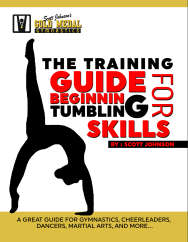
My new Beginner Tumbling Training Guide is published and ready for all to use. This is a great training aid for any and all programs who offer tumbling training. If you would like to order your copy, follow this link: http://www.amazon.com/gp/product/B0847D3VQC

I am a true believer in the neoprene material for relief of joint pain and discomfort. The following product is ideal for athletes who experience wrist pain while tumbling.

Looking for the perfect leotard for your little tumbler? This is a great leotard for the recreational tumbler and gymnast!!

Cheerleading and Tumbling, Gymnastics, Mental Training, Preparation, Skill Development, Tumbling

Eliminating Fears in Young Students

When young children are learning something new, it is very common they may have some apprehension. In some cases, they may be terrified. This is a natural occurance and a situation that should be dealt with delicately.

Learning gymnastics and tumbling skills are certainly exciting for most students who participate. However, there are elements that can be scary, especially for young children. Many of the skills require the student to go upside down, and for some, this can be a very scary experience.

Even skills as basic as the forward and back roll can be challenging for some students. So how does a coach deal with these situations? There may be certain tools in the gym that can be used to help the student become more comfortable. These may include a wedge mat, panel mats, or other items that assist the athlete in motion. In addition, the coach should be active in spotting the student to help them with confidence and reduce the fear emotion.

Most importantly, the child should never be forced to do a skill they are terrified of performing. I have seen students who just cannot duck their head under for the forward roll or feel comfortable with flipping backward on a back roll. Since these are unnatural motions, some have developed such an extreme fear that it prevents them of accomplishing the skill – at least for an extended period of time.

Through consistent drill training, students usually gain the confidence needed to accomplish the desired skill. Drills as simple as the rock n’ roll and the ” donkey kicks” on floor help students in understanding tumbling motions. These baby steps are beneficial in development.

For the safety, enjoyment, and productive development of teaching gymnastics and tumbling skills, approach the training in a positive and stress free environment. You could be training a future champion!!

dsc_40031119621626161690471.jpg

My new Beginner Tumbling Training Guide is published and ready for all to use. This is a great training aid for any and all programs who offer tumbling training. If you would like to order your copy, follow this link:

http://www.amazon.com/gp/product/B0847D3VQC


In addition, if you would like a personal training session or consultation with me, we can Skype a lesson. Email me at: scottjohnsongymnastics@gmail.com

The Best athletic wear for recreational gymnastics and tumbling!!

Front Handspring, Skill Development, Training, Tumbling

The Front Handspring Step-Out (Walkover)

front hndsprng stepout

The Front Handspring step-out, also known as the Front Walk-over in cheerleading and dance is a common skill and one that is used often in combination tumbling passes. It is also considered an elegant skill, if performed correctly, but difficult to learn properly for many athletes. Here I will share my thoughts and techniques that has worked well in teaching this skill.

As with so many skills, it is important to learn the prerequisites first so the student has the ability to learn the Front Handspring correctly. These prerequisites include, but not limited to, the handstand, bridge, lunge, and hurdle step.

There are several factors that go into play when developing these types of skills. For this particular skill, flexibility certainly is one of the most important factors. This flexibility concerns primarily the legs, back, and shoulders. Arm and body positioning is another factor that must be accomplished for a positive result. And finally, strength and aggression are important.

spotting front limber

The front limber is a skill that should be introduced and learned prior to learning the front handspring. This will prepare the student in understanding the dynamics of the skill. There are several good drills used in learning the front limber. The most effective drill that has worked well for my students is the bridge “rock and stand” motion.  This should be spotted by a qualified coach through the developmental stages.

While the student is in the bridge position, they will rock back and forth and as they rock toward the feet, have them stand upward making sure the student keeps their eyes on the floor and not looking upward or forward. Upon the finish of the skill, the body should be in a slightly arched position.

Limber position

Once the student understands the front limber, they are ready to begin learning the front walkover. The concept is very similar to the front limber, however, the student will keep their legs split throughout the skill and land on one leg. This is where flexibility plays a major roll. The farther the student can split their legs, the easier it is for the student to land with the lead leg under the torso. Shoulder flexibility also plays a roll which will allow the student to place the lead foot close to the hands.

20171006015256

When the student has learned (or trained and understands) the front walkover, they would be ready to perform the skill from a run and hurdle step. It is critical that the student has a proper hurdle step in order to perform the front handspring The Hurdle Step The Key Ingredient. Arms should be straight and extended up above the head and ears throughout the skill.

The arms should reach well in front of the body when placing the hands on the floor. It is important that the shoulders do not rock in front of the hands. The arms should remain straight and should create a blocking action (bounce) off the floor. The block should be felt on the palms of the hands (if the shoulders rock forward upon placing hands on the floor, the pressure would be on the fingers preventing the blocking motion).

finish pos of front walkover

The finish of the skill should be the same as in the standing front walkover. The major difference between the front walkover and front handspring step-out is the blocking motion off the arms.  The stronger the blocking motion, the more momentum created for connecting skills.

If the students follow this  type of training progression, they will learn the skill effectively.  It will take time and consistency but the results should be positive.  It is always important to remember to follow the proper techniques so the students will not develop bad habits.

dsc_40031119621626161690471.jpg

My new Beginner Tumbling Training Guide is published and ready for all to use. This is a great training aid for any and all programs who offer tumbling training. If you would like to order your copy, follow this link: http://www.amazon.com/gp/product/B0847D3VQC

Front Cover.Red Lettering

Benefits, Gymnastics, Skill Development, Sports, Training, Tumbling

How Can Gymnastics Benefit Your Child?

It is very important to keep children active and get involved with some type of physical activity. Especially in this modern age where technology has taken control and children get glued to their computers and mobile devices. In addition, the majority of public school systems have little to offer in terms of Physical Education and intramural sports – where many schools only offer PE classes as an option in the school curriculum.

However, when searching which activities are best to get your young child involved with, there are many choices. I believe Gymnastics is a great place to start!! There are many benefits in learning gymnastics as a young athlete.

All sports have their own physical attributes which need to be accomplished in order to be successful. For example, in sports such as basketball, track and field, and soccer, just to name a few, athletes need to be proficient in running and jumping as well as throwing and spinning. Dancers need to be flexible and learn complete body control and coordination.

The sport of gymnastics teaches most physical attributes that all sports require in order to be successful. Gymnastics entails training in flexibility, strength, agility, and coordination. It is important the students learn to run and jump effectively. Through consistent training, students will increase physical coordination and agility. The sport of gymnastics and tumbling entails training that enhance development in all parts of the body.

Skill development in gymnastics is typically a slow process due to the complexity of the skills involved. However, through time, students will learn and progress to higher level skills. It is through this development that students develop physical and emotional attributes that will be beneficial in other sports they may pursue.

Only a small percentage of students who participate in gymnastics at an early age will reach the highest level of competition. For students who participate in gymnastics at an early age and progress through several skill levels, they will have developed many physical and mental attributes that will help them become successful in another sport.

Not only is gymnastics and tumbling beneficial to students, it is a fun experience for most who participate. Give it a try – it could be a great experience!!

My new Beginner Tumbling Training Guide is published and ready for all to use. This is a great training aid for any and all programs who offer tumbling training. If you would like to order your copy, follow this link: http://www.amazon.com/gp/product/B0847D3VQC

These neoprene wrist supports are the best for gymnasts and cheerleaders experiencing wrist pain. The neoprene provides support and warmth to the joint to help relieve pain discomfort.

This is the best syle of leotards for recreational gymnastics. Get yours today!!

Athletes, Mobility, Parent, Preparation, Skill Development, Transition

Should Your Student or Child be Promoted?

In every youth sports program, there comes a time when the coaches need to make the decision of when to move a child up to the next level. This can be a very sensitive issue in many cases and a decision which can make or break a students’ confidence and morale. Not only does this decision effect the student, it has an important effect on the parent as well. There are many factors to consider when deciding to move a child to the next level.

Many programs have strict requirements which need to be met in order to qualify for mobility. This may be a scoring requirement or a skill requirement. In these cases, it is clearly identified when a student can qualify for mobility and no argument can be made. However, in other cases, mobility is a grey area and many programs use only discretion when considering to move a student up. In this scenario, it could cause conflict.

For many competitive team programs, mobility can only happen at the end or beginning of a season. Once an athlete is placed on a team, their position may require them to fulfill the entire season for the success of the team. In some sports that are considered more individualized, an athlete may be moved up if they meet the programs requirements.

The dynamics are similar in recreational programs as well, but the decision to move a student to the next level has a varied effect on the total program. Since there is not a competitive edge to this environment, the decision to move a child up is based primarily on availability and skill requirement.

Parents and students need to understand that it is to their benefit to excel at their current level before any mobility occurs. Coaches do not want to place a student in an environment where they will struggle and possibly be intimidated. There is a risk factor as well since the skills become more advanced. This is usually not a positive environment when a student is placed in a group where the students are much more advanced. It is always good to challenge an athlete but not to extremes where intimidation occurs.

However, It can be very frustrating for a student and parent when they are “held back” for reasons that only benefit the program. It is a common practice for some programs to hold back students for the benefit of creating a successful team environment. Although holding back students who have clearly met the skill requirements to move up, will certainly make the team stronger and more competitive.

So, is this a bad thing? Much depends on the program itself and how the dynamics work within the program. Some programs have such a large team program that there may be no spots available for new students to join. Mobility may not occur as quickly in these circumstances. In some cases, however, a student is held back for the sole purpose of a program wanting to win.

In these cases, the student will not be able to fulfill their own goals and ultimate potential. When a student is held back and not permitted to experience higher levels of sport, they are not able to exercise their growth in development. One result of this scenario may be the student becoming bored with their training environment and losing all motivation. https://scottjohnsonsgymexperience.com/2018/04/17/the-motivating-factor/ This may result in the student quitting the sport altogether or moving to another gym in hopes of getting placed in a higher level.

It can be a difficult situation for the coaching staff when discussing mobility to higher levels to the parents. Especially for those students who see teammates move up when they cannot follow. Parents need to understand that coaches are experienced and will make decisions that best benefit the student and the program. I have always believed that a student should be promoted if their skill level meets the requirements of the next level. Serious athletes want to progress, so let’s help them.

Scott Johnson – Olympic Champion

I am in the process of publishing my first training manual: “Beginner Tumbling Training” .  This will be a useful tool in training for all and any needing to learn proper technique and safety. Great for gymnastics, cheerleading, dance, martial arts, and more. I will keep you posted on that progress.

In addition, if you would like a personal training session or consultation with me, we can Skype a lesson. Private message me or email me at: scottjohnsongymnastics@gmail.com